
THERAPY FOR HAITIAN & HAITIAN-AMERICAN ADULTS — NY · FL · D.C.
A Haitian therapist you don't have to explain your family to.
You've had the session where you stop mid-sentence to give context. Who your aunt is and why her opinion carries weight. What it means that your mother still sends money home. Why "just set a boundary" isn't a plan when boundaries were never something you were allowed to have — when speaking up got called ungrateful, and disrespectful, and that was the end of it.
By the time you've explained it, half the session is gone and you're tired.
Online sessions from anywhere in New York, Florida, or Washington D.C. — so the nearest Haitian therapist doesn't have to be the one nearest you.No waitlist. Most people start within a week.
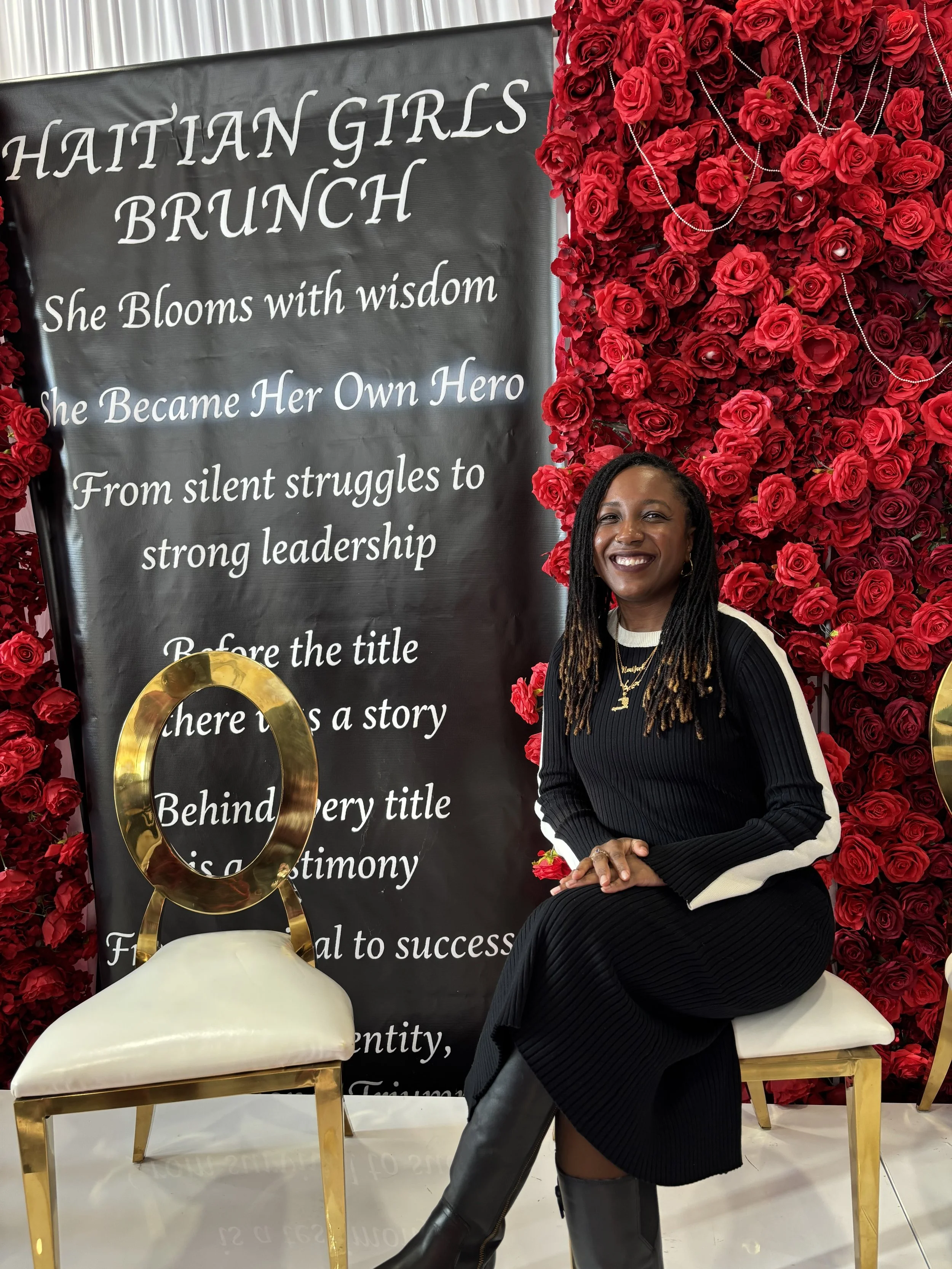
— KREYÒL PALE, KREYÒL KONPRANN —
Your Kreyòl doesn't have to be good here
I'm first-generation Haitian-American. Growing up, I watched trauma move through families without anyone naming it — passed down, worked around, never treated. I watched people carry things for decades because getting help wasn't something our community did, and because the mental health field had almost nobody in it who looked like us or understood where we came from.
So I became the therapist I wished my community had.
Not just for Haitian folks, though they're welcome here and you can move into Kreyòl with me. For anyone who's the first — first to go to college, first to move out, first to go to therapy, first to say out loud that the way things have always been done isn't working. A lot of us grew up caught in the same bind — shamed for not speaking Kreyòl well enough, or at all, and never given a space to practise where somebody wasn't correcting us. So we stopped trying. And then carried the guilt of having lost something nobody actually taught us.
And you won't be expected to say it perfectly.
You can speak it badly here. An Americanized accent. Only certain words. A sentence you're not sure you assembled right. It's still our mother tongue, and you're still allowed to use it.
I'll say the same about myself, because it matters: I'm Haitian-American and my Kreyòl is intermediate. I understand everything. I move between the two the way you probably do. You won't be the only person in the room reaching for a word.
— WHAT DOESN'T GET SAID —
In a lot of Haitian families, none of this is discussed
Not because nobody was struggling. Because struggling wasn't something you announced.
Here's what people bring me. You won't recognize all of it. Most people recognize more than they expected to.
Between two worlds
- You behaved one way inside the house and another way outside it, usually in secret
- Too American at home. Not American enough anywhere else
- Not Haitian enough, and not Black enough, depending on the room
- Getting disciplined for acting "too American"
- Learning your own culture as an adult, because nobody taught you growing up
Lekòl, Legliz, Lakay
- School, church, home. Anything outside those three didn't count and wasn't discussed
- Boundaries read as disrespect. Speaking up read as ungrateful
- Higher expectations for the daughters than the sons. Freedom was gendered
"Èske m sanble zanmi w?"
Do I look like your friend?
- The answer was no, and it settled the question of whether you got to speak freely to a parent for about the next twenty years
- As the first-generation daughter, everything was your responsibility
- Perfectionism, because the expectation was achievement and there was no second option
- Feeling like a late bloomer — no dating, no going out, no practice at any of it
- Love that arrived conditionally, attached to grades and behavior, until your worth became what you produce
What your parents couldn't give
- Provided for materially. Sent to school. Emotionally on your own
- Parents always working, so you figured it out yourself
- Emotionally immature parents who will likely never be able to name what they survived
- The mother-and-daughter wound of not being understood by her, and not being able to say so
- Your father as your first heartbreak — the neglect, or the betrayal, and a trust in men that never quite came back
- Becoming one parent's only support, and calling that closeness
- Parentified early, which turned into either codependency or hyper-independence
- And now, in mid-life, caring for ageing parents without the security they had at your age
What you inherited
- Watching unhealthy love get normalized — infidelity, other households, disrespect, as long as somebody was providing
- Siblings carrying different versions of the same childhood, which pushed you apart or fused you together
- Survival mode as an inheritance — you come from resilient people, you can push through anything, and burnout arrives anyway
- Cultural grief. What's happening in Haiti, what you want for it, and the xenophobia here
- Unprocessed grief about leaving — the earthquake, the conflict, the life that stayed behind
- Religious trauma from a church that had rules for you it didn't keep for itself
- Shame about your sexuality, and nowhere to put it
None of this is only Haitian, and I don't want to flatten anyone. But the particular combination — deep faith, high expectation, a history that gave people excellent reasons not to trust institutions, and a whole generation that survived by not stopping — shows up often enough that I stopped being surprised by it years ago.
And the reasons you haven't come
- You were told to pray about it. You did. It helped, and it wasn't enough on its own
- Family business stays in the family — and a therapist counts as outside the family
- Therapy is for people with real problems, and you've decided yours don't qualify
You're not betraying anyone by being here.
— BEING THE ONE WHO MADE IT —
What you owe, and what it's costing you
Somebody left. Somebody arrived here with very little and built something anyway. And then you got the education, or the job, or the apartment that was the entire point of it.
That is not a small thing to carry.
It shows up as guilt for having more than your parents did. As sending money without checking whether you can afford it. As being the family's translator, tech support, emergency contact, accountant, immigration adviser and therapist since you were about eleven.
And as the specific bind of not being allowed to be tired — because what you're tired from is what everyone else sacrificed for you to have.
"M'ap voye li Ayiti." I'm sending it to Haiti.
Sometimes they asked first whether you were still using it. You'd say yes. It went in the doum anyway.
You learned early that the question wasn't really a question, and that what was yours was only yours for as long as nobody needed it more.
This work isn't about cutting anyone off. That advice gets handed to first-generation adults constantly by people who have no idea what's being asked of them. It's about working out what's actually yours to carry, and what you picked up because nobody else was going to. Those are different things, and most people have never had room to tell them apart.
— SPIRITUALITY —
Whatever you believe now comes with you
If your faith is central to how you understand your life, it belongs in this room. I'm spiritual myself. You can talk about what manifestation or prayer does for you, what a scripture is holding you together with, and I'm not going to treat any of it as a symptom.
If church is where the injury happened, that belongs here too — and it comes up more than people expect.
The strictness that had a different set of rules for girls. Watching people preach one thing and live another. Being expected to hide the part of you that's LGBTQIA+, or to shrink it. And the loss that comes after leaving, when the people you grew up beside stop calling.
If you're rebuilding your spirituality on your own terms, this is a space for that. Some people find their way to Buddhism, or to a definition of God that finally fits. Some find their way toward Orisha, astrology, tarot, herbalism, Hoodoo, or the African and Haitian spiritual practices the church taught them to be ashamed of. None of that needs defending here.
And you can talk about your dreams — what they meant, who came, what you think you were being told — without a paragraph of explanation first.
— HOW I WORK —
Somatic and IFS-informed, in whichever language
I'm somatic, attachment, trauma, and IFS-informed. In practice that means we pay attention to what your body is doing while we talk, and we treat your patterns as protection rather than problems.
That matters here specifically. If you grew up reading the room to know whether it was safe, your body got extremely good at scanning — and it never got the message that it could stop. You can't think your way out of that. Your nervous system has to learn it's over, which is slower and more physical than most people expect.
— IS THIS A FIT? —
Let's find out before you book
This is probably a fit if
- You're a Haitian or Haitian-American adult, or the child of Caribbean immigrants
- You want to move between Kreyòl and English
- You're tired in a way sleep doesn't fix
- You've been the responsible one since before you were old enough to choose it
- You want to understand the pattern, not just get through the week
- You can commit to weekly or biweekly work over months
And probably not if
- You need same-day or crisis care (If that's where you are, call or text 988.)
- You're outside New York, Florida, or Washington D.C. — including in Haiti. My licences don't reach, and I'd rather tell you now than after you've booked
- You want a short, focused piece of work rather than something that takes time
- You need to use Medicaid or Medicare
You don't have to be Haitian to work with me. Most of my clients aren't. This page exists because if you are, there's a list of things you won't have to explain.
— WHERE MY CLIENTS ARE —
Online across New York, Florida, and Washington D.C.
All sessions are online, so where you live inside those three places doesn't matter — only that you're physically there during the appointment.
Most of my clients are in New York. In Brooklyn that's Flatbush and East Flatbush, Canarsie, Crown Heights, Flatlands and Midwood. Across Queens it's Queens Village, Cambria Heights, Springfield Gardens, Rosedale, Laurelton and St. Albans. Out on Long Island, Elmont, Valley Stream, Hempstead, Uniondale and Freeport. Plus Mount Vernon, Yonkers and New Rochelle in Westchester, and Spring Valley up in Rockland County.
In Florida, mostly Broward County — Miramar, Pembroke Pines, Weston, Davie, Plantation and Coral Springs — and Palm Beach County around Wellington, Boynton Beach and West Palm Beach. Also Fort Lauderdale, North Miami, Miami Lakes, Little Haiti, Orlando and the Keys.
In Washington, D.C., anywhere in the District.
No commute and no waiting room, which for a lot of people is the difference between going and meaning to go.
— WHAT TO EXPECT —
What sessions look like
| Languages | English, with Kreyòl welcome in session |
| Format | Online video, 45–60 minutes |
| Frequency | Weekly or biweekly to start |
| Fee | $225, with a sliding scale from $140 |
| Insurance | Out-of-network. Superbills provided |
| Where | Anywhere in New York, Florida, or Washington D.C. |
| First step | A free 20-minute consultation |
— COMMON QUESTIONS—
Questions people ask me
Where can I find a Haitian therapist near me?
Do you work with Haitian clients in South Florida?
How fluent is your Kreyòl?
I understand Kreyòl but I barely speak it. Is that a problem?
Can we switch between English and Kreyòl?
Do you work with people in Haiti?
Is this only for Haitian clients?
My family wouldn't approve of me doing this.
Do I have to talk about my family?
— WHENEVER YOU’RE READY —
You've been handling it on your own for a long time
Twenty minutes, free, no pressure. You tell me what's going on — in whichever language it arrives in — and we work out together whether I'm the right person for it.
If I'm not, I'll say so, and I'll help you find who is.
No waitlist. Most people start within a week.